Prediction markets are moving beyond being a niche Web3 concept. Today, entrepreneurs are exploring platforms where users can speculate on the outcomes of real-world developments.
That growing interest creates an important question for anyone planning to launch a prediction market platform: “Should you use a Polymarket clone script or build everything from scratch?”
The answer isn't simply about development cost. It depends on how quickly you want to enter the market, how much control you need, what makes your platform different, and how much technical responsibility you're prepared to take on.
Let's look at both approaches from a business perspective.
Polymarket Clone Script: The Faster Route to Market
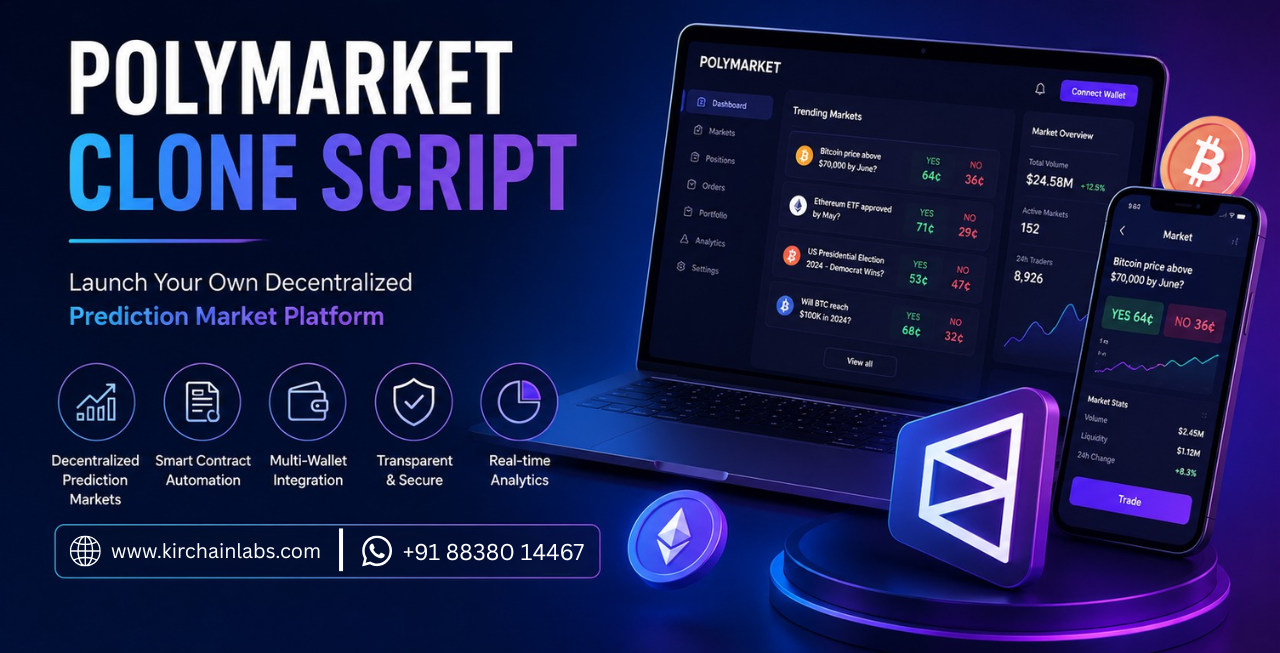
A Polymarket clone script is a ready-made prediction market software solution that is built around the core concepts users expect from modern prediction platforms.
Instead of developing every component from zero, entrepreneurs can begin with a pre-engineered foundation and customize elements such as branding, trading interfaces, user dashboards, wallets, market management, administration, and blockchain integrations.
The major advantage is straightforward: you start with a working foundation rather than a blank screen.
For startups testing a prediction market business idea, this can significantly reduce the time between concept and launch. More importantly, the saved development effort can be redirected toward liquidity, partnerships, user acquisition, market research, and community building.
But there's an important catch: not every clone script is created equally.
A cheap script with limited customization, questionable security practices, or restrictive licensing can become expensive when you eventually need to modify it. The real value lies in the underlying architecture, source-code accessibility, scalability, security, and customization capabilities.
Custom Prediction Market Development: Build Around Your Vision
Custom prediction market development takes the opposite approach.
Rather than adapting an existing platform, your development team designs the technology specifically around your business model. The trading mechanism, smart contracts, oracle architecture, APIs, user experience, admin controls, database structure, and other components can all be engineered according to your requirements.
This is particularly useful when your platform isn't intended to be another general-purpose prediction market.
For example, you might want to specialize in sports predictions, financial events, entertainment outcomes, or a particular geographic market. You may also want proprietary features that aren't available in conventional prediction-market software.
Custom development gives you considerably more control. The trade-off is that this flexibility requires a larger investment of time, money, testing, security engineering, and ongoing maintenance.
The Real Difference: Speed vs. Ownership
The easiest way to understand the decision is to think about what you are buying. With a clone solution, you're primarily buying a head start. With custom development, you're building an asset.
A clone can help you reach users sooner and validate whether people actually want your product. Custom software can give you deeper control once your business model has been proven.
Neither approach is automatically superior.
Imagine two founders.
· Founder A has a limited budget, wants to launch within a few months, and is still testing which prediction categories attract users. For this founder, a customizable prediction market clone script could make considerably more sense.
· Founder B already has a strong user community, substantial funding, and a unique trading mechanism that doesn't fit existing software. For this business, custom development could be the stronger long-term investment.
Cost Isn't the Only Factor
Searching for the cost of Polymarket clone script development can be tempting, but price alone shouldn't determine the decision.
A low upfront price doesn't necessarily mean a low total cost.
Consider what happens if the platform cannot scale when traffic increases, requires expensive modifications, lacks proper documentation, or depends heavily on the original vendor.
Likewise, custom development isn't automatically expensive in the long run. If proprietary technology becomes a major competitive advantage, the additional initial investment may generate significant value.
Instead of asking, “Which option costs less?” ask: “Which option gives my business the best return on development investment?”
That question leads to a much better decision.
Security Should Be a Deal-Breaker
Prediction platforms require more than an attractive interface.
Depending on the architecture, the technology may involve wallets, smart contracts, transactions, market-resolution mechanisms, APIs, user balances, and potentially substantial financial activity.
That means security needs to be considered before launch, not after something goes wrong.
If you're evaluating a Polymarket clone development company, investigate its security practices, smart-contract testing, architecture, source-code quality, upgrade process, documentation, and support model.
For custom development, independent code reviews and appropriate security audits should be incorporated into the development roadmap.
The objective isn't simply to launch quickly. It's to launch something users can trust.
A Hybrid Strategy May Be the Smartest Choice
There is a third option that businesses often overlook. You don't necessarily have to choose between a basic clone and a completely custom platform.
A practical strategy is to launch using a customizable prediction market solution, collect user feedback, understand which markets perform best, and then gradually introduce proprietary technology.
This approach reduces the risk of spending heavily on features nobody uses. Once you know what your audience actually wants, custom development becomes much more strategic.
Polymarket Clone Script vs. Custom Development: Final Verdict
So, which makes more sense?
Choose a Polymarket clone script if your priorities are faster deployment, lower initial development complexity, business validation, and customization without building every component from scratch.
Choose custom prediction market development if your platform requires unique technology, specialized functionality, complete architectural control, or a long-term competitive advantage built around proprietary software.
For many startups, the smartest path isn't about choosing the most technically sophisticated option. It's about choosing the option that matches their current stage.
Validate first. Differentiate next. Scale intelligently.
That's ultimately what makes a prediction market development strategy successful, not whether the platform started from a clone script or a blank codebase.







Write a comment ...